Entracte
(Curiosités numériques et centre de gravité)
Entrée de l’entracte
Le point de départ n’est pas un nombre, mais un prénom.
Bahia Bakari est la seule rescapée du crash du vol Yemenia IY626, survenu dans l’océan Indien en juin 2009.
Sa survie ne vient ni expliquer ni racheter l’événement.
Elle introduit un point de fixation humaine.
Le prénom Bahia ouvre simultanément un autre plan de résonance.
Bahia est aussi le nom d’un État du Brésil, pays directement lié à un autre événement déjà présent dans le corpus : le crash du vol AF447 reliant Rio à Paris, survenu quelques semaines plus tôt.
Ce dédoublement — un prénom et un territoire — ne produit pas de signification.
Il crée une surface de contact.
L’armoirie de l’État de Bahia offre à ce contact une forme visuelle concrète.

De la complexité de cette image, un élément se détache : le triangle flottant à hauteur des genoux de la figure féminine coiffée du bonnet phrygien.
Historiquement associé au Siècle des Lumières et à la Révolution de 1789, ce triangle n’est pas lu ici comme symbole, mais comme structure de disposition : une figure simple permettant de penser sommets, bases et axes.
C’est à partir de cette forme que s’organise l’observation suivante.
Disposition initiale
On considère trois événements aériens distincts, repérés par leurs numéros de vol :
- T888 — Air New Zealand, Perpignan, 27/11/2008 (cinéscriptographe du crash de Perpignan)
- AF447 — Rio–Paris, 01/06/2009 (cinéscriptographe du crash Rio-Paris)
- IY626 — Yemenia, 30/06/2009 (survivante : Bahia Bakari) (cinéscriptographe de Bahia)
Ils sont disposés selon une configuration fondée sur leur position géographique et narrative dans le corpus :
- T888 au sommet nord,
- AF447 et IY626 formant une base horizontale, respectivement sommets ouest et est.
L’événement aérien du sommet nord en appelle un autre :
- TE901 — DC-10 Air New Zealand, Mont Erebus, 28/11/1979 (cinéscriptographe du crash de Perpignan).
TE901 devient alors un nouveau sommet, le sommet sud, prolongeant la base vers le bas.
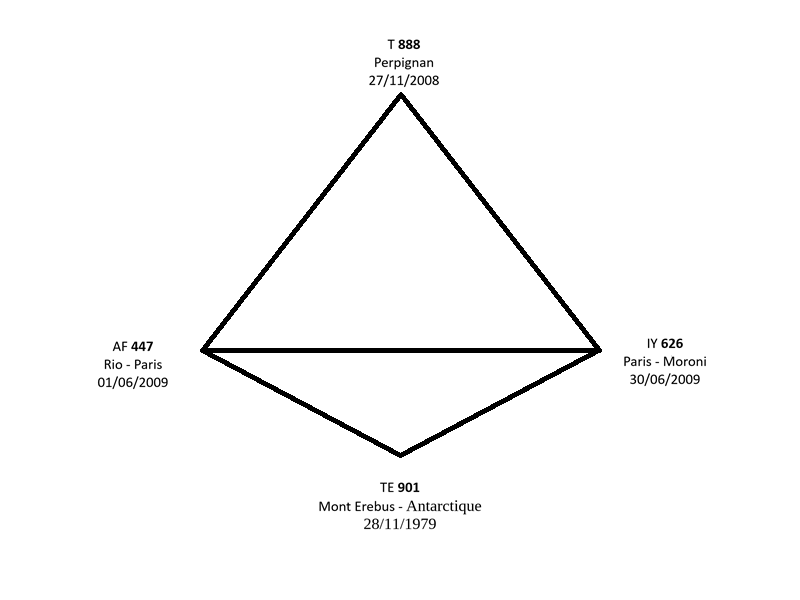
Deux axes apparaissent immédiatement : un axe nord–sud et un axe est–ouest, sans hiérarchie entre eux.
L’ensemble forme un « tétraèdre » — une figure à quatre sommets, dont chaque face triangulaire peut être lue indépendamment comme un système local de contraintes.
L’objectif n’est pas d’établir un lien causal entre ces événements, mais d’observer les curiosités numériques qui émergent lorsque leurs numéros sont mis en relation dans cette disposition.
Une première curiosité apparaît d’ailleurs dans la relation entre les sommets nord et sud :
888 + 901 = 1789 (année de la Révolution française, liée historiquement au triangle des Lumières)
Première fixation : l’écart de base
Entre les deux vols de la base horizontale, un écart attire l’attention par sa stabilité :
626 − 447 = 179
Le 179 devient un premier point de fixation.
Il entre en résonance avec un élément déjà présent dans le cinéscriptographe du crash Rio-Paris : la plaque d’immatriculation 719.
Il ne s’agit pas d’une égalité, mais d’un renversement: les chiffres sont identiques, leur ordre est déplacé.
Principe du chiffre déplacé
Ce phénomène ne relève ni d’un codage ni d’un calcul classique.
Dans le passage de 179 à 719 :
- les chiffres sont conservés,
- leur position interne change.
Le nombre ne se transforme pas : il se réoriente.
Ce principe n’opère ni par addition ni par soustraction.
Il relève d’une cinétique interne du nombre, où la structure prime sur le résultat.
Remontée vers le sommet nord
Curieusement, quand on remonte vers le sommet nord, cette logique de renversement se prolonge avec l’apparition du miroir exact de l’écart de base 179 : 971.
En effet, si l’on compare le sommet nord au sommet est, et que l’on observe la relation de ce résultat à l’écart de base, on obtient :
( 888 – 626 ) – 179 = 262 – 179 = 83
Ce 83 est conservé comme écart résiduel, comme une « tension de fermeture ».
Et si l’on réinjecte ce 83 au sommet nord, comme pour « équilibrer » le système par le haut, on obtient :
888 + 83 = 971
Le sommet nord devient alors un sommet virtuel idéal, le reflet exact de la dynamique de sa base.
Notons qu’en mathématiques, la différence entre un nombre et son miroir (comme 971 – 179 = 792) est toujours un multiple de 9 (792 / 9 = 88). On retrouve ici une résonance à notre point de départ 888.
Déplacement du sommet : 888 → 896
Dans une seconde étape, le sommet nord est légèrement déplacé.
Le nombre 888 est augmenté de 8 unités, devenant 896.
Ce déplacement minimal permet de tester la stabilité des relations numériques sans modifier la structure générale du « tétraèdre ».
Ce choix n’est pas arbitraire : le chiffre 8 est déjà présent dans le corpus, notamment à travers la huitième alerte enlèvement du cinéscriptographe de Bashung.
Ce déplacement fait glisser symboliquement le sommet de Perpignan vers Arles, lieu d’habitat d’Élise, situé dans les Bouches-du-Rhône (département 13), valeur qui apparaît également comme écart entre les sommets nord et sud (901 − 888 = 13).
Le 888, par ailleurs, fonctionne graphiquement comme répétition et boucle — on le retrouve notamment dans le caligramme du cinéscriptographe du séisme de L’ Aquila — ce qui renforce la lisibilité de ce déplacement comme un ajustement interne plutôt qu’une rupture.
Avec ce nouveau sommet, nous mesurons la « distance numérique » qui le sépare de ses appuis à la base :
- ( 896 − 447 ) + ( 896 − 626 ) = 449 + 270 = 719
Le 719, de la plaque d’immatriculation, réapparaît, non plus par renversement, mais par recomposition. Il devient une sorte de force de traction totale, au sens formel, que le triangle nord exerce sur la base est-ouest. 719 est un indice de cohésion de ce triangle : une signature de tension du triangle, l’empreinte numérique qui définit sa « verticalité » par rapport à sa base.
Ce retour confirme la cohérence interne du dispositif : le déplacement du sommet redistribue les relations sans les dissoudre.
Extension vers le sud : TE901
L’introduction du vol TE901 prolonge la configuration vers le sud.
Le résultat entre deux écarts de deux segments qui se suivent attire l’attention :
- ( 901 − 626 ) − (626 − 447 ) = 275− 179 = 96
Ce 96 apparaît comme un indice de déformation du triangle sud, quand il devient une forme « sous tension » ou « en torsion ». Le 96 apparaît comme une mesure de distorsion du sommet sud par rapport à la base.
Le 96 comme indice d’asymétrie
Si l’on additionne les sommets opposés du « tétraèdre » formé par la figure initiale :
- Sud + Est : 901 + 626 = 1527
- Nord + Ouest : 888 + 447 = 1335
L’écart entre ces deux ensembles est :
1527 − 1335 = 192
La moitié exacte de cet écart est :
192 / 2 = 96
Le 96 apparaît ainsi comme indice d’asymétrie : la valeur nécessaire pour équilibrer la figure.
Le 96 comme centre de gravité
Le 96 n’apparaît pas comme le résultat d’un calcul isolé.
Il émerge comme point de convergence, issu de la recomposition des écarts nord, base et sud.
Il agit comme centre de gravité numérique : un point autour duquel les relations cessent de se disperser.
Ce 96 trouve, a posteriori, un ancrage temporel précis : 6 avril 2009 — 96ᵉ jour de l’année, date du séisme de L’ Aquila.
Relié à la « tangente Delta », un élément du cinéscripotgraphe du séisme de L’ Aquila, le 96 devient à la géométrie de notre « tétraèdre » ce que la tangente Delta est à l’électricité : la mesure précise de son imperfection réelle.
Il ne s’agit ni d’annonce ni de causalité.
Le nombre ne prédit pas l’événement, et l’événement ne justifie pas le nombre.
Leur coïncidence devient lisible uniquement après coup.
Ce 96 montre que ce « tétraèdre »n’est pas un objet statique, mais un objet dont les forces sont en mouvement.
Le calcul ne révèle pas une vérité cachée : il rend visible une contrainte déjà à l’œuvre.
Lecture structurelle : tension et torsion
À ce stade, la figure peut être relue comme un système de contraintes.
La somme des écarts exercés depuis le sommet nord vers la base est de :
(896 − 447) + (896 − 626) = 449 + 270 = 719
La somme des écarts exercés depuis le sommet sud est de :
(901 − 447) + (901 − 626) = 454 + 275 = 729
La structure est presque équilibrée.
Une différence minimale de 10 unités subsiste entre le haut et le bas.
Dans cette lecture formelle :
- 719 peut être lu comme indice de tension,
- 96 comme indice de torsion.
Il ne s’agit pas d’une interprétation, mais d’une reformulation structurelle des relations déjà établies.
Remarque cinéscriptographique libre
Quand on considère le sommet déplacé 896, et qu’on le compare au sommet sud, l’écart vertical devient : 901 − 896 = 5
Ce 5 évoque, sans logique commune ni nécessité, le nom Cinquin, du cinéscriptographe de Sœur Emmanuelle.
Elle est d’ailleurs enterrée à Callian, dans le Var (83), valeur déjà apparue dans la chaîne différentielle.
Cette remarque n’explique rien.
Elle est un rapprochement latéral, non démonstratif.
Continuités de trajectoires
Le vol IY626 s’inscrit dans une chaîne comprenant le vol IY749, reliant Paris à Sanaa avant Moroni.
Ce 749 fait réapparaître le Lockheed L-749 Constellation, alias Princess Malabar, piloté par Alan Saint, crashé sur le Mont-Blanc.
Ces trajectoires dessinent une continuité de routes, de noms et de ruptures reliant les cinéscriptographes de Rio–Paris, de Bahia, de Perpignan, et par extension de L’ Aquila, de Bashung et de Sœur Emmanuelle.
Ces éléments ne forment pas un système, mais une constellation de rappels.
Sortie de l’entracte
Cet entracte ne propose ni clé ni révélation.
Il expose un champ de contraintes formelles, lisible après coup.
Le 96 n’explique rien.
Le 719 ne prouve rien.
Ils tiennent.
← Revenir · ↺ Sommaire · → Continuer
Interlude
(Numerical Curiosities and Center of Gravity)
Entrance to the Interlude
The point of departure is not a number, but a first name.
Bahia Bakari is the sole survivor of the crash of Yemenia flight IY626, which occurred in the Indian Ocean in June 2009.
Her survival neither explains nor redeems the event.
It introduces a point of human fixation.
The name Bahia simultaneously opens another plane of resonance.
Bahia is also the name of a state in Brazil, a country directly linked to another event already present in the corpus: the crash of flight AF447 from Rio to Paris, which occurred a few weeks earlier.
This doubling — a first name and a territory — produces no meaning.
It creates a surface of contact.
The coat of arms of the State of Bahia offers this contact a concrete visual form.
(Image: Coat of Arms of the State of Bahia. See image above)
From the complexity of this image, one element stands out: the triangle floating at knee height, held by the female figure wearing a Phrygian cap.
Historically associated with the Enlightenment and the French Revolution of 1789, this triangle is not read here as a symbol, but as a structural device — a simple figure allowing one to think in terms of summits, bases, and axes.
It is from this form that the following observation is organized.
Initial Configuration
Three distinct aerial events are considered, identified by their flight numbers:
- T888 — Air New Zealand, Perpignan, 27/11/2008 (cinéscriptographe of the Perpignan crash)
- AF447 — Rio–Paris, 01/06/2009 (cinéscriptographe of the Rio–Paris crash)
- IY626 — Yemenia, 30/06/2009 (survivor: Bahia Bakari) (cinéscriptographe of Bahia)
They are arranged according to a configuration based on their geographical and narrative position within the corpus:
- T888 at the northern summit,
- AF447 and IY626 forming a horizontal base, west and east summits respectively.
The aerial event at the northern summit calls forth another:
- TE901 — Air New Zealand DC-10, Mount Erebus, 28/11/1979 (cinéscriptographe of the Perpignan crash).
TE901 thus becomes a new summit, the southern summit, extending the base downward.
(Image of the “tetrahedron” and its coordinates. See image above)
Two axes immediately appear: a north–south axis and an east–west axis, without hierarchy between them.
The whole forms a tetrahedron — a four-vertex figure, each triangular face of which may be read independently as a local system of constraints.
The objective is not to establish a causal link between these events, but to observe the numerical curiosities that emerge when their flight numbers are placed in relation within this configuration.
A first curiosity appears in the relationship between the northern and southern summits:
888 + 901 = 1789,
the year of the French Revolution, historically linked to the Enlightenment triangle.
First Fixation: the Base Gap
Between the two flights forming the horizontal base, one gap draws attention through its stability:
626 − 447 = 179
179 becomes a first point of fixation.
It resonates with an element already present in the cinéscriptographe of the Rio–Paris crash: the license plate number 719.
This is not an equality, but a reversal: the digits are identical, their order displaced.
Principle of the Displaced Number
This phenomenon belongs neither to coding nor to classical calculation.
In the transition from 179 to 719:
- the digits are preserved,
- their internal positions change.
The number does not transform; it reorients itself.
This principle operates neither by addition nor subtraction.
It belongs to an internal kinetics of the number, in which structure prevails over result.
Ascent toward the Northern Summit
Curiously, as one moves back toward the northern summit, this logic of reversal is extended with the appearance of the exact mirror of the base gap 179: 971.
Indeed, if one compares the northern summit to the eastern summit and observes the relation of this result to the base gap, one obtains:
(888 − 626) − 179 = 262 − 179 = 83
This 83 is retained as a residual gap, a kind of “closing tension.”
And if this 83 is reinjected into the northern summit, as if to “balance” the system from above, one obtains:
888 + 83 = 971
The northern summit thus becomes an ideal virtual summit, the exact reflection of the dynamic of its base.
It may be noted that in mathematics, the difference between a number and its mirror (such as 971 − 179 = 792) is always a multiple of 9 (792 ÷ 9 = 88).
Here again, a resonance appears with our point of departure, 888.
Displacement of the Summit: 888 → 896
In a second stage, the northern summit is slightly displaced.
The number 888 is increased by 8 units, becoming 896.
This minimal displacement allows the stability of the numerical relations to be tested without modifying the general structure of the tetrahedron.
The choice is not arbitrary: the digit 8 is already present in the corpus, notably through the eighth missing-child alert in the cinéscriptographe of Bashung.
This displacement symbolically shifts the summit from Perpignan toward Arles, the place of residence of Élise, located in the Bouches-du-Rhône (department 13), a value that also appears as the gap between the northern and southern summits (901 − 888 = 13).
Moreover, 888 functions graphically as repetition and loop — it notably appears in the calligram of the cinéscriptographe of the L’Aquila earthquake — reinforcing the legibility of this displacement as an internal adjustment rather than a rupture.
With this new summit, we measure the “numerical distance” separating it from its supports at the base:
(896 − 447) + (896 − 626) = 449 + 270 = 719
719, from the license plate, reappears — no longer through reversal, but through recomposition.
It becomes a kind of total traction force, in a formal sense, exerted by the northern triangle on the east–west base.
719 is an index of cohesion of this triangle: a signature of tension, the numerical imprint that defines its “verticality” relative to its base.
This return confirms the internal coherence of the device: the displacement of the summit redistributes the relations without dissolving them.
Extension toward the South: TE901
The introduction of flight TE901 extends the configuration southward.
The result between two successive segment gaps draws attention:
(901 − 626) − (626 − 447) = 275 − 179 = 96
This 96 appears as an index of deformation of the southern triangle, when it becomes a form “under tension” or “in torsion.”
96 thus appears as a measure of the distortion of the southern summit relative to the base.
96 as an Index of Asymmetry
If one adds the opposite summits of the tetrahedron formed by the initial figure:
- South + East: 901 + 626 = 1527
- North + West: 888 + 447 = 1335
The gap between these two sums is:
1527 − 1335 = 192
Exactly half of this gap is:
192 ÷ 2 = 96
96 thus appears as an index of asymmetry: the value required to balance the figure.
96 as Center of Gravity
96 does not appear as the result of an isolated calculation.
It emerges as a point of convergence, arising from the recomposition of the northern, base, and southern gaps.
It acts as a numerical center of gravity — a point around which relations cease to disperse.
This 96 finds, a posteriori, a precise temporal anchoring: April 6, 2009, the 96th day of the year, the date of the L’Aquila earthquake.
Linked to the “Delta tangent,” an element of the cinéscriptographe of the L’Aquila earthquake, 96 becomes to the geometry of our tetrahedron what the Delta tangent is to electricity: the precise measure of its real imperfection.
This involves neither announcement nor causality.
The number does not predict the event, and the event does not justify the number.
Their coincidence becomes readable only after the fact.
This 96 shows that the tetrahedron is not a static object, but one whose forces are in motion.
The calculation does not reveal a hidden truth; it makes visible a constraint already at work.
Structural Reading: Tension and Torsion
At this stage, the figure can be reread as a system of constraints.
The sum of the gaps exerted from the northern summit toward the base is:
(896 − 447) + (896 − 626) = 449 + 270 = 719
The sum of the gaps exerted from the southern summit is:
(901 − 447) + (901 − 626) = 454 + 275 = 729
The structure is almost balanced.
A minimal difference of 10 units remains between top and bottom.
In this formal reading:
- 719 may be read as an index of tension,
- 96 as an index of torsion.
This is not an interpretation, but a structural reformulation of relations already established.
Free Cinéscriptographic Remark
When one considers the displaced summit 896 and compares it to the southern summit, the vertical gap becomes:
901 − 896 = 5
This 5 (Cinq in French) evokes, without shared logic or necessity, the name Cinquin, from the cinéscriptographe of Sister Emmanuelle.
She is buried in Callian, in the Var (83), a value already encountered in the differential chain.
This remark explains nothing.
It is a lateral association, non-demonstrative.
Continuities of Trajectories
Flight IY626 is part of a chain that includes flight IY749, linking Paris to Sanaa before Moroni.
This 749 brings back the Lockheed L-749 Constellation, alias Princess Malabar, piloted by Alan Saint, which crashed on Mont Blanc.
These trajectories draw a continuity of routes, names, and ruptures linking the cinéscriptographes of Rio–Paris, Bahia, and Perpignan — and by extension those of L’Aquila, Bashung, and Sister Emmanuelle.
These elements do not form a system, but a constellation of echoes.
Exit from the Interlude
This interlude offers neither key nor revelation.
It exposes a field of formal constraints, readable after the fact.
96 explains nothing.
719 proves nothing.
They hold.